2205 问题 E: Cleaning Robots(L)
时间限制: 1s 内存限制: 256MBThe new ICPC town has N junctions (numbered from 1 to N) which are connected by N−1 roads. It is possible from one junction to go to any other junctions by going through one or more roads. To make sure all the junctions are well-maintained, the government environment agency is planning to deploy their newest advanced cleaning robots. In addition to its cleaning ability, each robot is also equipped with a movement ability such that it can move from one junction to any other junctions connected by roads. However, as you might have guessed, such robots are not cheap. Therefore, the agency is considering the following deployment plan.
Let Tk be the set of junctions which should be cleaned by the kth robot (also known as, the robot's task), and |Tk|≥1 be the number of junctions in Tk. The junctions in Tk form a path, i.e. there exists a sequence of v1,v2,…,v|Tk| where vi∈Tk and vi≠vj for all i≠j such that each adjacent junction in this sequence is connected by a road. The union of T for all robots is equal to the set of all junctions in ICPC town. On the other hand, no two robots share a common junction, i.e. Ti∩Tj=∅ if i≠j.
To avoid complaints from citizens for an inefficient operation, the deployment plan should be irreducible; in other words, there should be no two robots, i and j, such that Ti∪Tj forms a (longer) path. Note that the agency does not care whether the number of robots being used is minimized as long as all the tasks are irreducible.
Your task in this problem is to count the number of feasible deployment plan given the town's layout. A plan is feasible if and only if it satisfies all the above-mentioned requirements.
For example, let N=6 and the roads are {(1,3),(2,3),(3,4),(4,5),(4,6)}. There are 5 feasible deployment plans as shown in the following figure.
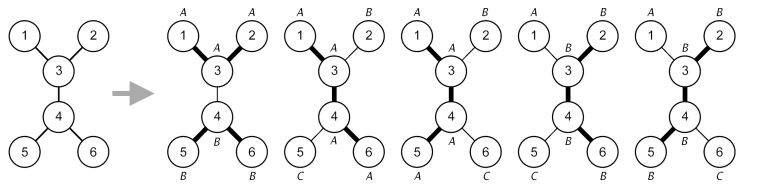
· The first plan uses 2 robots (labeled as A and B in the figure) to clean {1,2,3} and {4,5,6}.
· The second plan uses 3 robots (labeled as A, B, and C in the figure) to clean {1,3,4,6}, {2}, and {5}.
· The third plan uses 3 robots to clean {1,3,4,5}, {2}, and {6}.
· The fourth plan uses 3 robots to clean {1}, {2,3,4,6}, and {5}.
· The fifth plan uses 3 robots to clean {1}, {2,3,4,5}, and {6}.
No other plans are feasible in this case. For example, the plan {{1,3},{2},{4,5,6}} is not feasible as the task {1,3} and {2} can be combined into a longer path {1,3,2}. The plan {{1,2,3,4},{5},{6}} is also not feasible as {1,2,3,4} is not a path.
Input begins with a line containing an integer: N (1≤N≤100000) representing the number of junctions. The next N−1 lines each contains two integers: uiui vivi (1≤ui<vi≤N) representing a road connecting junction ui and junction vi. It is guaranteed that it is possible from one junction to go to any other junctions by going through one or more roads.
Output in a line an integer representing the number of feasible deployment plans. As this output can be large, you need to modulo the output by 1000000007.
样例输入
6
1 3
2 3
3 4
4 5
4 6
样例输出
5
比赛公告
题号:2201,2202,2203,2204,2205,2206,2207,2208,2209,2210
点击上方导航栏的训练,点击题库,寻找题号即可找到对应题目,比赛结束后,请通过训练->题库->寻找对应题目的方式做题
因为不确定因素太多,就不再安排大家轮流讲题了,大家做不出题可以在测试结束后去题库找对应的题目看题解,希望大家自觉练习,认真练习,考核测试会采取不同与现在测试的方式,两个月后综合测试成绩不达标者会退出实验室,希望大家认真对待