NOIP
#include <iostream>
using namespace std;
int main(){
    const int SIZE = 100;
    int height[SIZE], num[SIZE], n, ans;
    cin>>n;
    for (int i = 0; i < n; i++) {
        cin>>height[i];
        num[i] = 1;
        for (int j = 0; j < i; j++) {
            if ((height[j] < height[i]) && (num[j] >= num[i]))
                num[i] = num[j]+1;
        }
    }
    ans = 0;
    for (int i = 0; i < n; i++) {
        if (num[i] > ans) ans = num[i];
    }
    cout<<ans<<endl;
}
输入:
6
2 5 3 11 12 4
输出:
(序列重排)全局数组变量 a 定义如下:
const int SIZE = 100;
int a[SIZE], n;
它记录着一个长度为 n 的序列 a [1], a[2], …,a[ n ] 。
现在需要一个函数,以整数 p (1 ≤ p ≤ n ) 为参数,实现如下功能:将序列 a 的前 p 个数与后 n–p 个数对调,且不改变这 p 个数(或 n – p 个数)之间的相对位置。例如,长度为 5 的序列 1, 2, 3, 4, 5 ,当 p = 2 时重排结果为 3, 4, 5, 1, 2 。
有一种朴素的算法可以实现这一需求,其时间复杂度为 O( n ) 、空间复杂度为 O( n) :
void swap1(int p){
    int i, j, b[SIZE];
    for (i = 1; i <= p; i++)
        b[ ① ] = a[i];
    for (i = p + 1; i <= n; i++)
        b[i - p] = ② ;
    for (i = 1; i <= ③ ; i++)
        a[i] = b[i];
}
我们也可以用时间换空间,使用时间复杂度为 O(n2) 、空间复杂度为 O(1) 的算法:
void swap2(int p){
    int i, j, temp;
    for (i = p + 1; i <= n; i++) {
        temp = a[i];
    for (j = i; j >= ④ ; j--)
        a[j] = a[j - 1];
        ⑤ = temp;
    }
}(二叉查找树)二叉查找树具有如下性质:每个节点的值都大于其左子树上所有节点的值、小于 其右子树上所有节点的值。试判断一棵树是否为二叉查找树。
输入的第一行包含一个整数 n,表示这棵树有 n 个顶点,编号分别为 1, 2, …, n ,其中编号为 1 的为根结点。之后的第 i 行有三个数 value, left_child, right_child ,分别表示该节点关 键字的值、左子节点的编号、右子节点的编号;如果不存在左子节点或右子节点,则用 0 代替。输 出 1 表示这棵树是二叉查找树,输出 0 则表示不是。
#include <iostream>
using namespace std;
const int SIZE = 100;
const int INFINITE = 1000000;
struct node {
    int left_child, right_child, value;
};
node a[SIZE];
int is_bst(int root, int lower_bound, int upper_bound){
    int cur;
    if (root == 0)return 1;
    cur = a[root].value;
    if ((cur > lower_bound) && ( ① ) &&
    (is_bst(a[root].left_child, lower_bound, cur) == 1) && (is_bst(②,③,④) == 1))
        return 1;
    return 0;
}
int main(){
    int i, n;
    cin>>n;
    for (i = 1; i <= n; i++)
        cin>>a[i].value>>a[i].left_child>>a[i].right_child;
    cout<<is_bst( ⑤ , -INFINITE, INFINITE)<<endl;
    return 0;
}本题中,我们约定布尔表达式只能包含 p, q, r三个布尔变量,以及“与”(∧)、“或”(∨)、“非”(¬)三种布尔运算。如果无论 p,q,r如何取值,两个布尔表达式的值总是相同,则称它们等价。
例如,(p∨q)∨r 和 p∨(q∨r) 等价,p∨¬p 和 q∨¬q 也等价;而 p∨q 和 p∧q 不等价。那么,两两不等价的布尔表达式最多有____个。
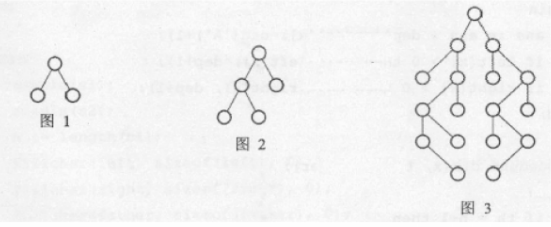
对于一棵二叉树,独立集是指两两互不相邻的节点构成的集合。例如,图 1 有 5 个不同的独立集(1 个双点集合、3 个单点集合、1 个空集),图 2 有 14 个不同的独立集。那么,图 3 有____个不同的独立集。
#include <iostream>
using namespace std;
int n, i, temp, sum, a[100];
int main(){
    cin>>n;
    for (i = 1;i <= n;i++)
        cin>>a[i];
    for (i = 1;i <= n - 1;i++)
        if (a[i] > a[i + 1]) {
            temp = a[i];
            a[i] = a[i + 1];
            a[i + 1] = temp;
        }
    for (i = n;i >= 2;i--)
        if (a[i] < a[i - 1]) {
            temp = a[i];
            a[i] = a[i - 1];
            a[i - 1] = temp;
        }
    sum = 0;
    for (i = 2;i <= n - 1;i++)
        sum += a[i];
    cout<<sum / (n - 2)<<endl;
    return 0;
}
输入:
8
40 70 50 70 20 40 10 30
输出:____
#include <iostream>
using namespace std;
int n, i, ans;
int gcd(int a, int b){
    if (a % b == 0)
        return b;
    else
        return gcd(b, a%b);
}
int main(){
    cin>>n;
    ans = 0;
    for (i = 1;i <= n;i++)
        if (gcd(n,i) == i)ans++;
    cout<<ans<<endl;
}
输入:120
输出:____
#include <iostream>
using namespace std;
const int SIZE = 20;
int data[SIZE];
int n, i, h, ans;
void merge(){
    data[h-1] = data[h-1] + data[h];
    h--;
    ans++;
}
int main(){
    cin>>n;
    h = 1;
    data[h] = 1;
    ans = 0;
    for (i = 2;i <= n;i++){
        h++;
        data[h] = 1;
        while (h > 1 && data[h] == data[h-1])
            merge();
    }
    cout << ans << endl;
}
1、输入:8
输出:____
2、输入:2012
输出:____
#include <iostream>
#include <string>
using namespace std;
int lefts[20], rights[20], father[20];
string s1, s2, s3;
int n, ans;
void calc(int x, int dep){
    ans = ans + dep*(s1[x] - 'A' + 1);
    if (lefts[x] >= 0) calc(lefts[x], dep+1);
    if (rights[x] >= 0) calc(rights[x], dep+1);
}
void check(int x){
    if (lefts[x] >= 0) check(lefts[x]);
    s3 = s3 + s1[x];
    if (rights[x] >= 0) check(rights[x]);
}
void dfs(int x, int th){
    if (th == n){
        s3 = "";
        check(0);
        if (s3 == s2){
            ans = 0;
            calc(0, 1);
            cout<<ans<<endl;
        }
        return;
    }
    if (lefts[x] == -1 && rights[x] == -1){
        lefts[x] = th;
        father[th] = x;
        dfs(th, th+1);
        father[th] = -1;
        lefts[x] = -1;
    }
    if (rights[x] == -1){
        rights[x] = th;
        father[th] = x;
        dfs(th, th+1);
        father[th] = -1;
        rights[x] = -1;
    }
    if (father[x] >= 0)dfs(father[x], th);
}
int main(){
    cin>>s1;
    cin>>s2;
    n = s1.size();
    memset(lefts, -1, sizeof(lefts));
    memset(rights, -1, sizeof(rights));
    memset(father, -1, sizeof(father));
    dfs(0, 1);
}
输入:
ABCDEF
BCAEDF
输出:____
(排列数)输入两个正整数 n,m(1≤n≤20,1≤m≤n),在 1~n 中任取 m 个数,按字典序从小到大输出所有这样的排列。
例如输入:
3 2
输出:
1 2
1 3
2 1
2 3
3 1
3 2
#include<iostream>
#include<cstring>
using namespace std;
const int SIZE = 25;
bool used[SIZE];
int data[SIZE];
int n, m, i, j, k;
bool flag;
int main(){
    cin>>n>>m;
    memset(used, false, sizeof(used));
    for (i = 1; i <= m; i++){
        data[i] = i;
        used[i] = true;
    }
    flag = true;
    while (flag){
        for (i = 1; i <= m-1; i++)cout<<data[i]<<"";
        cout << data[m] << endl;
        flag =①;
        for (i = m; i >= 1; i--){
            ②;
            for (j = data[i]+1; j <= n; j++)
                if (!used[j]){
                    used[j] = true;
                    data[i] =③;
                    flag = true;
                    break;
                }
            if (flag){
                for (k = i+1; k <= m; k++)
                    for (j = 1; j <=④; j++)
                        if (!used[j]){
                            data[k] = j;
                            used[j] = true;
                            break;
                        }
                ⑤;
            }
        }
    }
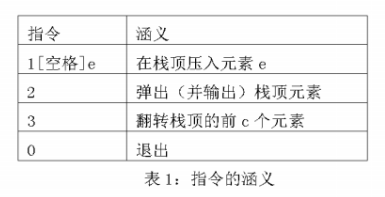
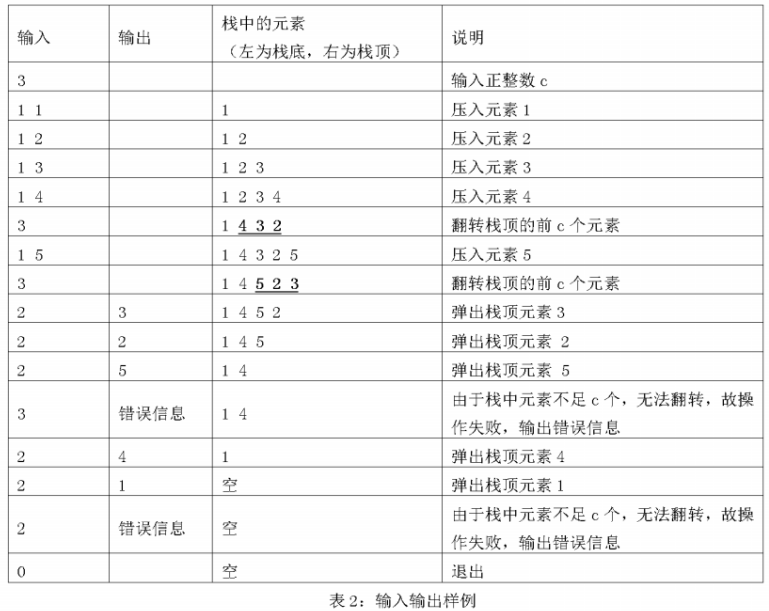
}(壳栈)小 Z 设计了一种新的数据结构“新壳栈”。首先,它和传统的栈一样支持压入、弹出操作。此外,其栈顶的前 c 个元素是它的壳,支持翻转操作。其中,c > 2 是一个固定的正整数,表示壳的厚度。小 Z 还希望,每次操作,无论是压入、弹出还是翻转,都仅用与 c 无关的常数时间完成。聪明的你能帮助她编程实现“新壳栈”吗?
程序期望的实现效果如以下两表所示。其中,输入的第一行是正整数 c,之后每行输入都是一条指令。另外,如遇弹出操作时栈为空,或翻转操作时栈中元素不足 c 个,应当输出相应的错误信息。
#include <iostream>
using namespace std;
const int NSIZE = 100000,CSIZE = 1000;
int n, c, r, tail, head, s[NSIZE], q[CSIZE];
//数组 s 模拟一个栈,n 为栈的元素个数
//数组 q 模拟一个循环队列,tail 为队尾的下标,head 为队头的下标
bool direction, empty;
int previous(int k){
    if (direction)
        return ((k + c - 2) % c) + 1;
    else
        return (k % c) + 1;
}
int next(int k){
    if (direction)
        ①;
    else
        return ((k + c - 2) % c) + 1;
}
void push(){
    int element;
    cin>>element;
    if (next(head) == tail) {
        n++;
        ②;
        tail = next(tail);
    }
    if (empty)
        empty = false;
    else
        head = next(head);
    ③= element;
}
void pop(){
    if (empty) {
        cout<<"Error: the stack is empty!"<<endl;
        return;
    }
    cout<<④<<endl;
    if (tail == head)
        empty = true;
    else {
        head = previous(head);
        if (n > 0) {
            tail = previous(tail);
            ⑤= s[n];
            n--;
        }
    }
}
void reverse(){
    int temp;
    if (⑥== tail) {
        direction = !direction;
        temp = head;
        head = tail;
        tail = temp;
    }else
        cout<<"Error: less than "<<c<<" elements in the stack!"<<endl;
}
int main(){
    cin>>c;
    n = 0;
    tail = 1;
    head = 1;
    empty = true;
    direction = true;
    do{
        cin>>r;
        switch (r) {
            case 1: push();break;
            case 2: pop();break;
            case 3: reverse();break;
        }
    } while (r != 0);
    return 0;
}某系统自称使用了一种防窃听的方式验证用户密码。密码是 n 个数 s1,s2,, , sn,均为 0 或 1。该系统每次随机生成 n 个数 a1,a2,, , an,均为 0 或 1,请用户回答 (s 1a1+s 2 a2+… +s n an)除以 2 的余数。如果多次的回答总是正确,即认为掌握密码。该系统认为,即使问 答的过程被泄露,也无助于破解密码——因为用户并没有直接发送密码。然而,事与愿违。 例如,当 n=4 时,有人窃听了以下 5 次问答:
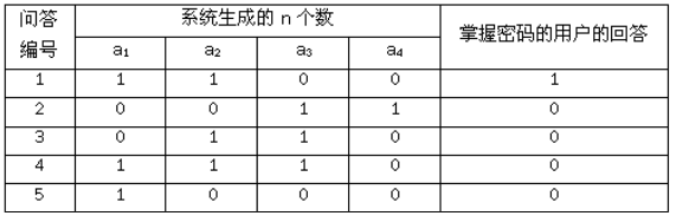
就破解出了密码 s1= _ , s2= _ ,s3= _, s4= _。(结果之间用空格隔开即可)
现有一只青蛙,初始时在 n 号荷叶上。当它某一时刻在 k 号荷叶上时,下一时刻将等概率 地随机跳到 1,2,, , k 号荷尔蒙叶之一上,直至跳到 1 号荷叶为止。当 n=2 时,平均一 共跳 2 次;当 n=3 时,平均一共跳 2.5 次。则当 n=5 时,平均一共跳 _____次。

#include <iostream>
#include <string>
using namespace std;
int main() {
    string str;
    cin>>str;
    int n = str.size();
    bool isPlalindrome = true;
    for (int i = 0;i < n/2;i++) {
        if (str[i] != str[n-i-1]) isPlalindrome = false;
    }
    if (isPlalindrome)
        cout<<"Yes"<<endl;
    else
        cout<<"No"<<endl;
}
输入:
abceecba
输出:________
#include <iostream>
using namespace std;
int main(){
    int a, b, u, v, i, num;
    cin>>a>>b>>u>>v;
    num = 0;
    for (i = a;i <= b;i++)
        if (((i % u) == 0) || ((i % v) == 0))
            num++;
    cout<<num<<endl;
    return 0;
}
输入:
1 1000 10 15
输出:________
#include <iostream>
using namespace std;
int main(){
    const int SIZE = 100;
    int height[SIZE], num[SIZE], n, ans;
    cin>>n;
    for (int i = 0;i < n;i++) {
        cin>>height[i];
        num[i] = 1;
        for (int j = 0;j < i;j++) {
            if ((height[j] < height[i]) && (num[j] >= num[i]))
                num[i] = num[j]+1;
        }
    }
    ans = 0;
    for (int i = 0;i < n;i++) {
        if (num[i] > ans) ans = num[i];
    }
    cout<<ans<<endl;
}
输入:
8
3 2 5 11 12 7 4 10
输出:________
#include <iostream>
#include <cstring>
using namespace std;
const int SIZE = 100;
int n, m, p, a[SIZE][SIZE], count;
void colour(int x, int y){
    count++;
    a[x][y] = 1;
    if ((x > 1) && (a[x - 1][y] == 0)) colour(x - 1, y);
    if ((y > 1) && (a[x][y - 1] == 0)) colour(x, y - 1);
    if ((x < n) && (a[x + 1][y] == 0)) colour(x + 1, y);
    if ((y < m) && (a[x][y + 1] == 0)) colour(x, y + 1);
}
int main(){
    int i, j, x, y, ans;
    memset(a, 0, sizeof(a));
    cin>>n>>m>>p;
    for (i = 1;i <= p;i++) {
        cin>>x>>y;
        a[x][y] = 1;
    }
    ans = 0;
    for (i = 1;i <= n;i++)
        for (j = 1;j <= m;j++)
            if (a[i][j] == 0) {
                count = 0;
                colour(i, j);
                if (ans < count)
                    ans = count;
            }
    cout<<ans<<endl;
    return 0;
}
输入:
6 5 9
1 4
2 3
2 4
3 2
4 1
4 3
4 5
5 4
6 4
输出:________
(序列重排)全局数组变量 a 定义如下:
const int SIZE=100;
int a[SIZE],n;
它记录着一个长度为 n 的序列 a[1] ,a[2] ,, , a[n] 。现在需要一个函数,以整数 p(1 ≤p≤ n) 为参数, 实现如下功能: 将序列 a 的前 p 个数与后 n-p 个数对调, 且不改变这 p 个数(或 n-p 个数)之间的相对位置。例如,长度为 5 的序列 1, 2,3,4,5,当 p=2 时重排结果为 3,4, 5,1,2。有一种朴素的算法可以实现这一需求,其时间复杂度为 O(n) 、空间复杂度为 O(n) :
void swap1(int p){
int i, j, b[SIZE];
    for (i = 1;i <= p;i++)
        b[①] = a[i];
    for (i = p + 1;i <= n;i++)
        b[i - p] = a[i];
    for (i = 1;i <= n;i++)
        a[i] = b[i];
}
我们也可以用时间换空间,使用时间复杂度为O(n^2)、空间复杂度为 O(1) 的算法:
void swap2(int p){
    int i, j, temp;
    for (i = p + 1;i <= n;i++) {
        temp = a[i];
        for (j = i;j >=②;j--)
            a[j] = a[j - 1];
        ③ = temp;
        }
}
事实上,还有一种更好的算法,时间复杂度为O(n)、空间复杂度为O(1):
void swap3(int p){
    int start1, end1, start2, end2, i, j, temp;
    start1 = 1;
    end1 = p;
    start2 = p + 1;
    end2 = n;
    while (true) {
        i = start1;
        j = start2;
        while ((i <= end1) && (j <= end2)) {
            temp = a[i];
            a[i] = a[j];
            a[j] = temp;
            i++;
            j++;
        }
        if (i <= end1)
            start1 = i;
        else if (④) {
            start1 =⑤;
            end1 =⑥;
            start2 = j;
        }else
            break;
    }
}(两元序列)试求一个整数序列中,最长的仅包含两个不同整数的连续子序列。如有多个子 序列并列最长,输出任意一个即可。例如,序列“ 1 1 2 3 2 3 2 3 3 1 1 1 3 1 ”中,有 两段满足条件的最长子序列,长度均为 7,分别用下划线和加粗斜体标出。
#include <iostream>
using namespace std;
int main(){
    const int SIZE = 100;
    int n, i, j, a[SIZE], cur1, cur2, count1, count2,
    ans_length, ans_start, ans_end;
    //cur1, cur2 分别表示当前子序列中的两个不同整数
    //count1, count2 分别表示 cur1, cur2 在当前子序列中出现的次数
    cin>>n;
    for (i = 1;i <= n;i++)
        cin>>a[i];
    i = 1;
    j = 1;
    //i, j 分别表示当前子序列的首尾,并保证其中至多有两个不同整数
    while ((j <= n) && (a[j] == a[i]))
        j++;
    cur1 = a[i];
    cur2 = a[j];
    count1 =①;
    count2 = 1;
    ans_length = j - i + 1;
    while (j < n) {
        j++;
        if (a[j] == cur1)
            count1++;
        else if (a[j] == cur2)
            count2++;
        else {
            if (a[j - 1] ==② ) {
                while (count2 > 0) {
                    if (a[i] == cur1)
                        count1--;
                    else
                        count2--;
                    i++;
                }
                cur2 = a[j];
                count2 = 1;
            }else {
                while (count1 > 0) {
                    if (a[i] == cur1)
                        ③ ;
                    else
                        ④ ;
                    i++;
                }
                ⑤ ;
                count1 = 1;
            }
        }
        if (ans_length < j - i + 1) {
            ans_length = j - i + 1;
            ans_start = i;
            ans_end = j;
        }
    }
    for (i = ans_start;i <= ans_end;i++)
        cout<<a[i]<<' ';
    return 0;
}把 M 个同样的球放到 N 个同样的袋子里,允许有的袋子空着不放,问共有多少种不同 的放置方法? (用 K 表示 )。 例如, M=7 ,N=3 时, K=8 ;在这里认为和是同一种放置方法。 问: M=8 ,N=5 时, K=_____ 。